Heading 3
Block quote
Heading 4
Heading 1
Heading 2
Heading 5
Heading 6
Lorem ipsum dolor sit amet, consectetur adipiscing elit, sed do eiusmod tempor incididunt ut labore et dolore magna aliqua. Ut enim ad minim veniam, quis nostrud exercitation ullamco laboris nisi ut aliquip ex ea commodo consequat. Duis aute irure dolor in reprehenderit in voluptate velit esse cillum dolore eu fugiat nulla pariatur.
Ordered list
- Item 1
- Item 2
- Item 3
Unordered list
Text link
Bold text
Emphasis
Superscript
Subscript
When designing software architecture, choosing between microservices and monolithic approaches is a crucial decision that impacts scalability, development speed, and maintenance. Understanding the strengths and trade-offs of each helps developers pick the right fit for their projects.
What is a Monolithic Architecture?
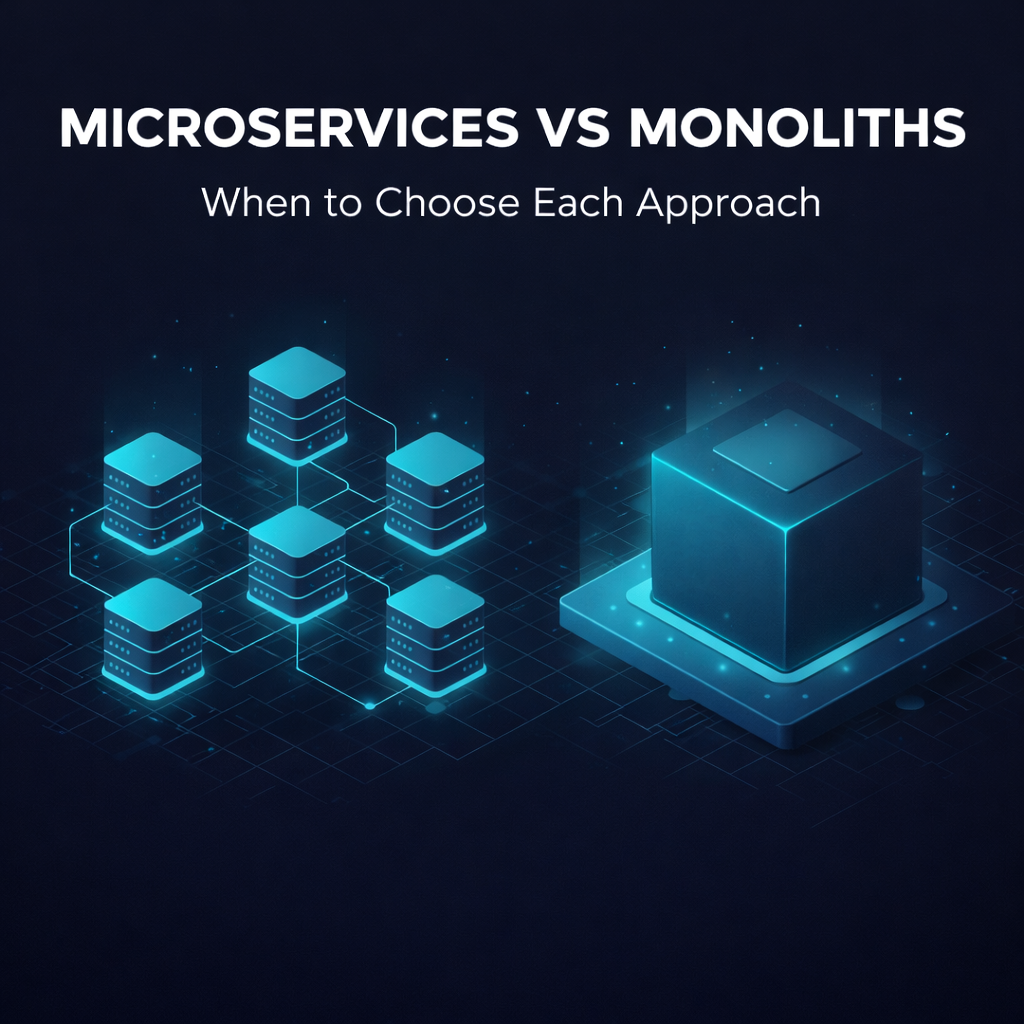
A monolithic architecture is a single unified codebase where all components of an application are tightly integrated and run as one service. It’s straightforward to develop and deploy initially but can become complex as the application grows.
What are Microservices?
Microservices architecture breaks an application into small, independent services that communicate over networks. Each service handles a specific business function and can be developed, deployed, and scaled independently.
When to Choose Monoliths
- Small to Medium Projects: When the project is relatively simple or has limited scope.
- Faster Initial Development: Easier to build and deploy quickly with fewer moving parts.
- Tight Team Collaboration: Works well when teams are small and co-located.
- Simpler Testing and Debugging: Everything in one place makes it easier to test and troubleshoot.
When to Choose Microservices
- Large, Complex Systems: Ideal for applications with multiple distinct business domains.
- Independent Scaling: Scale parts of the app separately based on demand.
- Faster Feature Deployment: Teams can develop and deploy services independently.
- Technology Flexibility: Different services can use different technologies best suited to their tasks.
- Resilience: Failure in one service doesn’t necessarily bring down the whole system.
Final Thoughts
There’s no one-size-fits-all answer. Start with what fits your current needs and team size. Many projects begin as monoliths and evolve into microservices as complexity grows. Evaluate your business goals, team structure, and long-term maintenance plans before making the choice.