Heading 3
Block quote
Heading 4
Heading 1
Heading 2
Heading 5
Heading 6
Lorem ipsum dolor sit amet, consectetur adipiscing elit, sed do eiusmod tempor incididunt ut labore et dolore magna aliqua. Ut enim ad minim veniam, quis nostrud exercitation ullamco laboris nisi ut aliquip ex ea commodo consequat. Duis aute irure dolor in reprehenderit in voluptate velit esse cillum dolore eu fugiat nulla pariatur.
Ordered list
- Item 1
- Item 2
- Item 3
Unordered list
Text link
Bold text
Emphasis
Superscript
Subscript
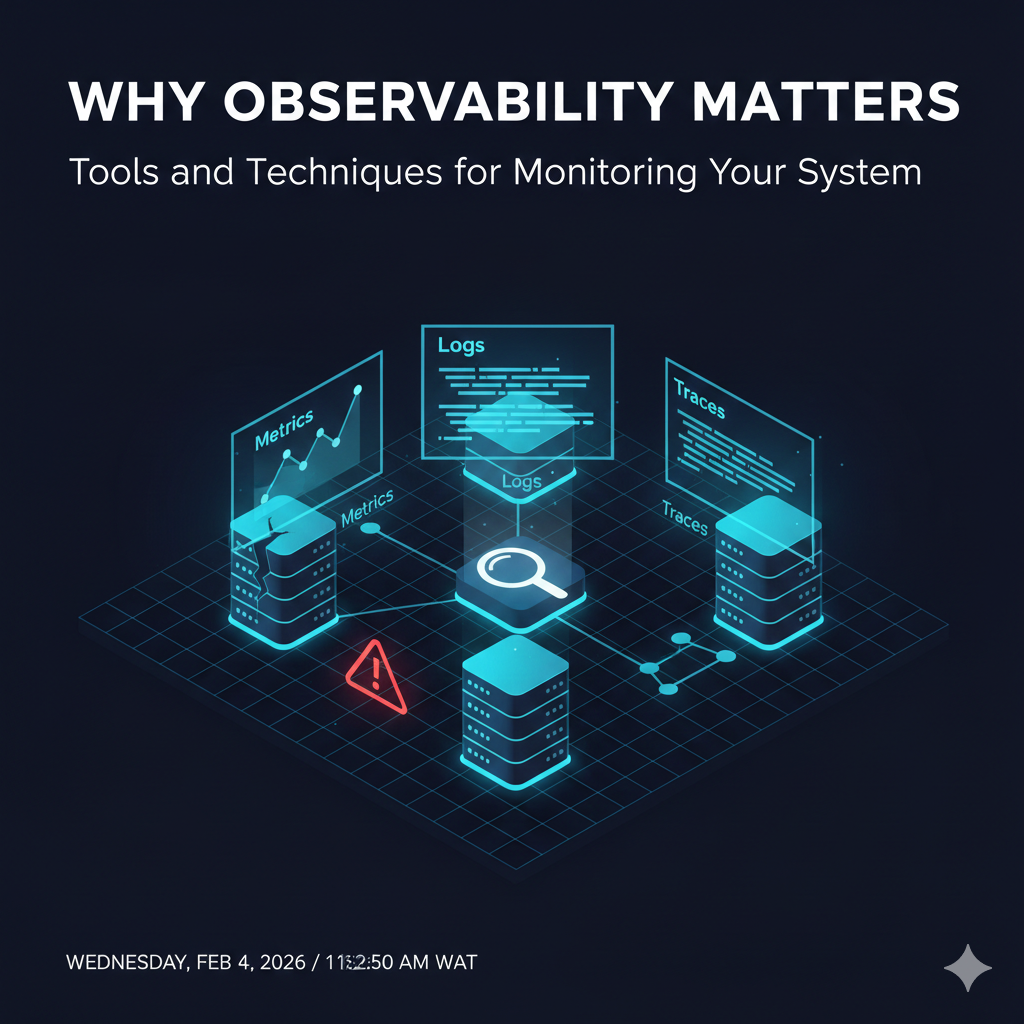
Observability is essential for understanding the internal state of your systems through external outputs like logs, metrics, and traces. It enables proactive issue detection, faster troubleshooting, and improved system reliability.
Why Observability is Important
- Early Problem Detection: Catch issues before they impact users.
- Faster Debugging: Understand the root cause quickly with detailed insights.
- Performance Optimization: Monitor system behavior to identify bottlenecks.
- Capacity Planning: Use data to forecast scaling needs.
Key Observability Tools
- Logging: Collect detailed event records to track system activity (e.g., ELK Stack, Fluentd).
- Metrics: Aggregate numerical data to monitor system health (e.g., Prometheus, Grafana).
- Tracing: Follow requests through distributed systems for end-to-end visibility (e.g., Jaeger, Zipkin).
Techniques to Improve Observability
- Instrument Your Code: Add hooks for collecting logs, metrics, and traces.
- Use Distributed Tracing: Track requests across microservices.
- Set Up Alerts: Notify teams when metrics cross thresholds.
- Dashboards: Visualize data for real-time monitoring.
Conclusion
Observability is key to maintaining robust and performant systems. Leveraging the right tools and techniques ensures you stay ahead of issues and maintain smooth operations.